The various interior styles seen aboard liners and cruise ships in the last 150 years have been covered in our series of articles on the developments of passenger ship interior design between 1880 and the present while discussing the most important interior architects and vessels of that period. It is therefore useful to provide an overview and a more or less chronological breakdown of the main interior design styles with their characteristics, mentioning a few ship-examples for each. The division below is, of course, subjective—for instance, considering luxury large vessels , cruise yachts, and residential cruise ships as having the same style interiors—but given the many similarities and overlap, this could be justifiable. Subjective or not, the overview below provides a basic insight into developments in liner and cruiseship interior design over roughly the past 150 years.
- Victorian style
The Victorian era covers the duration of Victoria’s reign as Queen of the United Kingdom of Great Britain and Ireland, from 1837 until her death in 1901.
In the beginning Victorian ship interiors featured the opulent and large-scale saloon as the primary social and dining area for first-class passengers (the most expensive accommodation was, in fact, called saloon class before it was called first class). However,soon a dedicated ladies cabin was introduced and later after the 1870s, the addition of dedicated smoking room for men marked a shift towards more gender-specific areas, moving away from the saloon’s role as a mixed social space. The trend later changed, with smoking rooms becoming more inclusive of women, and the overall interior architecture evolved rapidly including a rapid growth of new public spaces to be used by both sexes. The saloon was now used just for dining.
Victorian interiors were designed to be luxurious, opulent, with ornate details, rich dark colors, and heavy furnishings. Grand staircases were a prominent feature in many liner interiors. Later Victorian ships, such as the Servia (Cunard Line, 1884), incorporated modern features like electrical lighting and music rooms, which can be compared to a drawing-room (an after dinner lounge to retreat for conversation) ashore.

- Edwardian style
The Edwardian era was a period in the early 20th century spanning the reign of King Edward VII, the eldest son of Queen Victoria, from 1901 to 1910 which is commonly extended to the start of the First World War in 1914. It was heavily influenced by the Arts and Crafts Movement which promoted simple design and an appreciation for the handmade opposed to mass production in the Victorian age.
This era is renowned for its aesthetic innovation and cultural changes. As London was the world center for progress and fashion, the Edwardian interior design era clearly showed these cultural changes, emphasizing elegant, bright spaces with subtle colors, floral patterns, simple details and lighter furniture compared to the Victorian era rsulting in an overall atmosphere of spaciousness.
Edwardian ship interiors, exemplified by liners like the famous Titanic (White Star Line, 1912) featured luxurious spaces with amenities such as swimming pools, Turkish baths, squash courts, as well as formal louges and dining rooms (in fact Titanic featured a mix of different interior styles which was quite common those days onboard ships needing to attract an international clientele).

Another example of a liner with Edwardian style interiors is the preserved Edwardian-era passenger liner, the Keewatin. She was originally owned by Canadian Pacific Rail and built in 1907 by the Fairfield Shipbuilding and Engineering Co Ltd. of Glasgow, Scotland. Nowadays visitors can still experience her gorgeous interiors, from the formal dining room and lounges to the former crew quarters at her permanent berth at the Great Lakes Museum in Kingston, Ontario, Canada.

- Liners with classic interiors
When launching their first ocean-greyhound Kaiser Wilhelm der Grosse (14,349GRT) in 1897, North German Lloyd had (interior) architect Johann Georg Poppe (1837 – 1915) design her interiors. It was the first time one designer was made responsible for the interiors of an entire ocean liner. Lavish Neo-Baroque interiors were the result, heavily ornamented and overcrowded public spaces, exactly what Poppe was known for. He chose this Baroque revival style because it was immensely popular in Germany at the time and it indeed made Kaiser Wilhelm der Grosse a favorite with German passengers. Kaiser Wilhelm de Grosse was is an example of a liner with a classic interior where one style is the predominant style, in this case Neo-Baroque.

- Liners featuring a mix of classic styles
At the beginning of the 20th century until the start of World War I, many of the most important liners featured a mix of different interior styles. This was quite common those days onboard ships needing to attract an international clientele.
Examples hereof are:
- Imperator 1913, 52,117GRT owned by the Hamburg America Line
The architect and designer Charles Mewès (1858 – 1914) was responsible for the interior design of the Imperator and her sister ships Bismarck and Vaterland (both 1914). Not everyone was pleased with her interiors, one German critic commented on the prevalence of French-style décor on the new ship:
Louis XVI seems to be the real Imperator…judging by the decorative effects with which the world’s biggest liner is embellished…the ladies saloon in Colonial, the smoking room in Flemish, the swimming pool in Pompeiian, the wintergarten in Louis XVI, the parlor in Louis XVI. – Louis XVI everywhere. Where is there any manifestation of present-day German style…the company, of course, must cater to the international public, especially Americans.”
He was right, as public spaces like the Ritz-Carlton restaurant with its adjacent winter garden/palm court in the Directoire-style and the Victorian-style Turkish baths next to the pool were other examples.. It was quite an array of different interior styles, all of them non-German…

- The Aquitania 1914, 52,117GRT owned by the Cunard Line
The Aquitania’s passenger accommodation was superior to anything seen on the North Atlantic before. The first class drawing room was decorated in the Adam style, copied from certain features in Landsdowne House in London. First class public rooms showed prints of English seaports and portraits of Royalty and prominent people of the day. The smoking rooms for the three classes were each done in completely different styles, while the main restaurant was decorated in Louis XIV style and the grill room in Jacobean style, inspired by a 17th-century room from the Old Palace in Bromley-by-Bow, now on display at the Victoria & Albert Museum in London.

(Later, after WWI, the mixture of styles approach was abandoned, as ocean liners like Ile de France, L’Atlantique, Normandie, Rex, Conte di Savoa, Bremen, Hamburg, Queen Mary, and Queen Elizabeth were all ‘ships-of-state,’ floating showcases of the best a country had to offer in terms of art, (interior) design, and naval architecture).
- Art deco 1910 – 1939
Art Deco-started in France around 1910 and was a popular style until 1940. The name Art Deco was related to the 1925 world exhibition Exposition internationale des arts décoratifs et industriels modernes in Paris, France and being the most popular style of the era, its introduction into passenger shipping was just a matter of time. Art Deco passenger ship interiors were opulent and modern, characterized by geometric shapes, sleek lines, rich colors and luxurious materials like polished metal, exotic woods, and glass. These designs led to luxurious private accommodations and dramatic, large-scale public spaces, such as grand dining rooms,multi-deck lounges , bars and even onboard shopping galleries. Ships featured original works of art, including high ceilings, elaborate decor like sculpted reliefs, murals, decorative glass panels and lighting by prominent artists designed to be awe-inspiring. Famous examples include the French CGT owned liners Ile de France (43,153GRT, 1927) and Normandie, (79,280GRT, 1935). One of the finest examples of stunning Art Deco public spaces is the main dining room on the Normandie, which was illuminated by 12 tall pillars of Lalique glass flanked by 38 matching columns along the walls. At 93 metres, it was longer than the Hall of Mirrors in the palace of Versailles earning the Normandie the nickname “Ship of Light”.

The Cunard liners Queen Mary (80,774GRT, 1936) and Queen Elizabeth (83,673GRT, 1939) also featured gorgeous Art Deco interiors albeit in a more quiet version, far less glitzy and extreme than as CGT’s Normandie. Cunard management was quite nervous they would turn out to be too modern and feared this would not be appreciated by her future British passengers. However, the Observation Bar on board Queen Mary is seen as an Art Deco masterpiece.

- Modernist passenger ship interiors
Modernist passenger ship interiors, a departure from traditional conventions and classical styles evolving significantly from 1925-1965, are characterized by a modern aesthetic incorporating clean lines, open-plan layouts, functional and adaptable furniture and minimalist designs. Often natural materials such as wood, but also new ones like molded plastics, chromium or bakelite (which could withstand humid climates many liners sailed to very well) are used, making the designs functional yet futuristic. Surfaces are smooth with little to no ornamentation or decoration. There is no connection with historical styles whatsoever. Designers integrated adaptable, space-saving modular furniture and sliding walls, at the same time respecting the ship’s structure by keeping it visible. Atomic-inspired designs were introduced in the late 50s and early 60s.
Principal Modernist interior designers:
Danish Modernism: Danish architects and designers, renowned for their modern architecture, integrated their distinctive style into passenger ships, creating “floating ambassadors” of Danish Modernism through their designs and furniture. Key figures include Kay Fisker, Palle Suenson, and Kay Kørbing, whose work graced Danish and other Scandinavian-owned passenger ships from the mid-1920s to the mid-1960s.
Italian Modernism: Italian designers Gio Ponti, Gustavo Pulitzer Finali and Nino Zoncada were prominent figures who contributed to the luxurious interiors of many passenger ships. Pulitzer Finali delivers a masterpiece with the interiors of the Victoria for owners Lloyd Triestino in 1930 which is launched in 1931 in Trieste. In her functional and sober modern interiors, the ship’s frame often remains in plain sight.

Another fine example is the Orion, built in 1934 for the Orient Steam Navigation Company. Colin Anderson, Orient Line’s CEO had asked New Zealand interior architect Brian O’Rorke to design the interiors of their new liner and told him he wanted an original, modern ship. O’Rorke did an excellent job. Apart from being the first British ocean liner fitted with airconditioning, more importantly, Orion is said to be the first passenger ship with interiors truly following modernist principles.

- Classic interiors in modern cruise ships
Here, modern cruise ships blend classic elegance with modern flair by incorporating traditional details like warm color schemes, wood panelling, ornate mouldings, antique and nautical touches alongside contemporary design elements. This style creates a timeless, sophisticated atmosphere, seen in public areas like grand lobbies, dining rooms, bars, theatres, and libraries, but also applied to private staterooms where for example we see modern technology like large, flat-screen TVs placed in custom-built cabinets to blend in with the classic surroundings.
Apart from elaborate Art Deco designs, some modern ships that use a “modern classic” style, balance traditional ornamentation with sleek, modern lines.
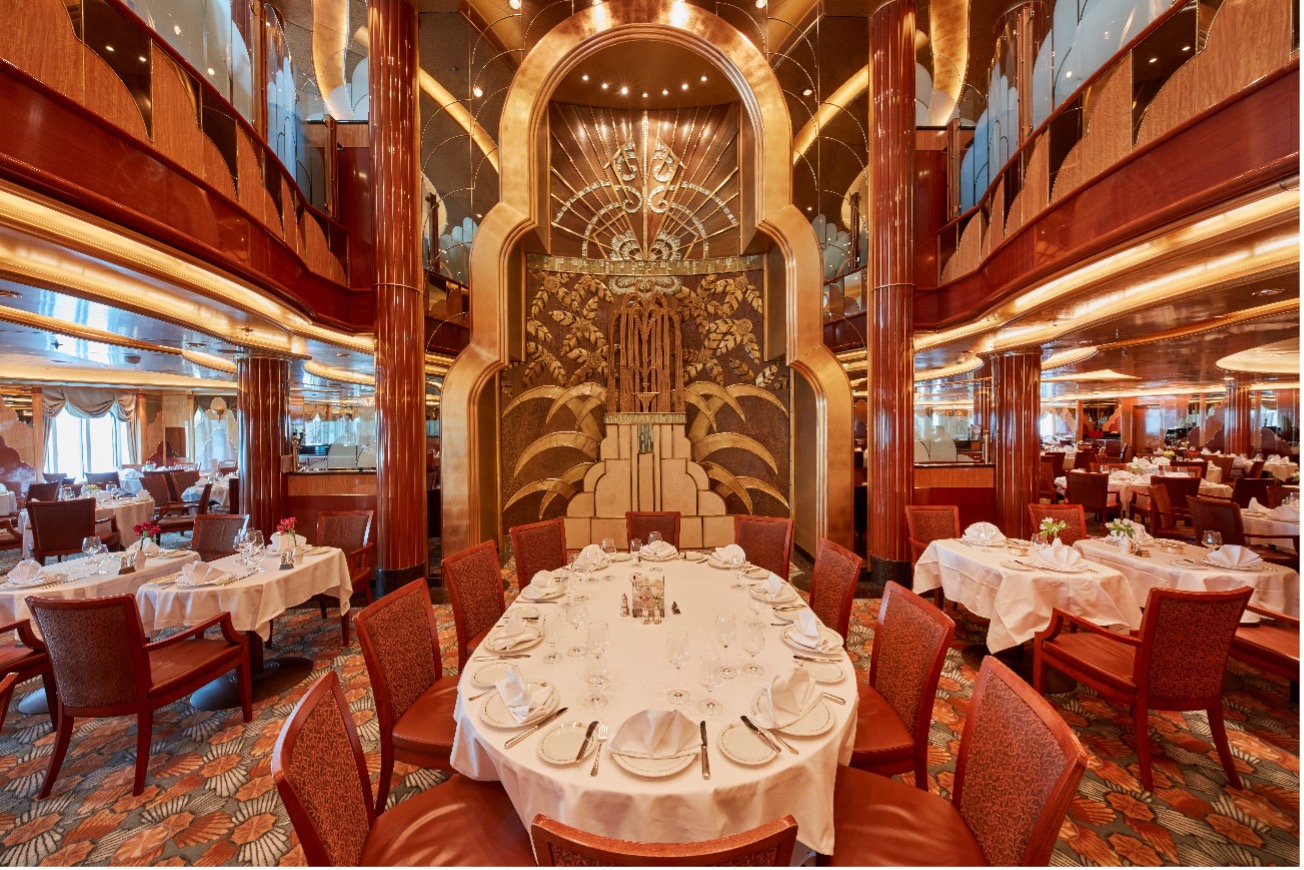
A fine example is Cunard Cruises’ Queen Elizabeth, launched in 2010. Boarding however, one would believe having stepped into a 1930’s hotel. As a tribute to the previous two Queens, Queen Mary (1936) and Queen Elizabeth (1940), she features many Art Deco interior touches like the decorative element in the middle of her Britannia Restaurant bringing to mind the most famous of Art Deco buildings, the Chrysler Building in New York.

Another modern cruise ship featuring classically themed designs is the Art Deco French Quarter onboard Carnival Cruises’ Mardi Gras ( 2020, 181,00GT). This $1 billion 6500 (max.) passenger cruise liners’ interiors were designed by Petu Kummala, senior director of design & architecture at Carnival Cruise Line. In the French Quarter area of the ship the focal point is the Brass Magnolia Jazz Bar which reminds one of late night drinking in a New Orleans jazz bar with the use of low mood-lighting elements,its herringbone flooring and the room-spanning plant design wall covering.

- Theme interiors
We can safely say that one company, Messageries Maritimes, “invented” themed interiors onboard its liners. The interiors of their ships related to the destination country they sailed to. For example their liners Champollion (1921) and Mariette-Pacha (1926) running between Marseille and Alexandria had beautifully decorated interiors with Egyptian motifs which could be found everywhere on the ship from the carpets with lotus and papyrus patterns to the lift cages’ decorative metalwork. Champollion featured Egyptian-style statues and a painting of an ancient Egyptian barque adorning the magnificent glass-roofed main hall. At the time, there was a world-wide interest in all things Egyptian (“Nile-style”) after the discovery of the tomb of Tutankhamon by British archeologist Howard Carter in 1922. Later ships were likewise decorated, Felix Roussel (1930) sailed on the route to the Far East and was given interiors with an Indo-Chinese twist, while the Aramis‘ (1932) interiors showed Greek-Cretan influences. Messageries Maritimes designing its liners in this way wanted to present more modern ships compared to the French liners with their Beaux-arts and later Art deco interiors customary until then. Also, they wanted to show elements of both France and its colonies in the interiors of their ships.
In many cases themed interior designs enhance the onboard experience Themed designs can align with a cruise line’s brand, such as Cunard’s tribute to classic ocean liners or NCL’s American theme. as we clearly see on the line’s Pride of America (2005, 80,400GT) with her American-style guest services area and Cadillac diner. They can also tell a story or create a specific atmosphere, whether it’s creating a fantasy world like onboard the Disney Cruise Line ships or a historical period referred to.

Two obvious examples are Disney Cruise Line’s fantasy-inspired motifs bringing a magical, story-driven atmosphere and Carnival Cruise Line’s Joe Farcus-designed (he was their leading architect for many years) glitzy and bold Las Vegas-style cruise ships featuring flashy, bold designs with elements like neon lights, futuristic decor, and large, eye-catching art pieces serving as focal points often found in atriums, bars and lounges. Carnival uses this style for a fun, vibrant, high-energy atmosphere, their trademark.
Also we also mentioned elsewhere in this article as separate interior styles, Viking Ocean Cruises’ Scandinavian-influenced nature-inspired ships with interiors creating a “residential modernism” style and Cunard Line’s focus on classic Ocean Liner style vessels like their Queen Elizabeth (2010), showcasing Art Deco elements. Their ships can also be regarded as having themed interiors.
- 1980’s/ 1990’s style
Many of the cruise ships (re-)built during the 198o’s/1990’s era follow the same interior design style. Ships of well-known cruise ship operators in this period like for example Epirotiki Cruises and Chandris Lines featured a mix of understated elegance and functional design, mostly being converted passenger ferries and older liners. Their interiors often incorporated classic styling with solid furniture and durable materials like brass and formica, resulting in a more traditional luxury. Ships like Epirotiki’s Jason (1967, 5,250 GRT), a former ferry, and the Amerikanis (1952, 19,900GRT) a well-known Chandris ship, illustrate the enduring, if slightly dated, design standards of the period.

However despite their age, with a focus on durable, comfortable, and functional spaces including thick carpets and well-built furniture. these ships did offer a sense of luxury and even grandeur.
From the seventies until the fall of the Soviet Union in 1991, the Soviet Union operated the largest cruiseship fleet in the world. They played an important role in acquiring western currencies. Soviet cruise ship interiors in the 1980’s featured bright colors (especially the furniture), with the dark wood of the sixties and seventies having been replaced by light finishes, chrome and brass and sometimes even psychedelic patterns, reflecting a contemporary and functional design yet distinctly Soviet style. The overall impression was still one of utilitarian but warm design, with public areas representative of the era’s trends within the Soviet Union but with design influences from the West visible however.
1990’s cruise ship interior design was characterized by bright, sometimes “busy” color palettes with materials like brass, marble and faux woods as well as large, multi-story atriums, often with a soaring height and a large piece of art at the centre creating a sense of spaciousness and grandeur. This era saw the construction of the world’s largest cruise ships, starting with the Sovereign of the Seas (1988, 73,190GRT, Royal Caribbean Int.). The goal was to emulate opulent hotels and resorts on land, often with an emphasis on creating a “destination” experience within the ship.

This new “entertainment architecture” was introduced by American interior architect Joe Farcus, Carnival Cruises’ leading ship interior architect. The design focus was on creating an upbeat atmosphere and Las Vegas-style spectacle, rather than the contemporary emphasis on creating a calm and intimate feel. Interiors often featured a mix of bold colors and patterns, including vibrant colors in carpets, upholstery and wall coverings, sometimes creating somewhat chaotic or “busy” interiors. Many ships featured distinct, themed public spaces, such as a library a theater, or a casino, each with its own design elements. Carnival Cruises’ Fascination-series of cruise ships, eight sister ships taken into service from 1990 to 1998 all feature specific themes, for example: Ecstasy – reflects the urban scene, Sensation – where sounds and lights must stimulate the human senses, Imagination – classical details and mythology and Paradise – reminiscent of former famous passenger ships.
In general, the 1990s were the era of the “megaship.” As ships got bigger, so did the public spaces. This allowed for more amenities and a more hotel-like atmosphere, with spacious promenades, dining rooms, and lounges.
- Scandinavian style
Scandinavian passenger ship interiors are characterized by a blend of natural elements, minimalist design and functionality, creating a serene and homely atmosphere. Key features include the use of light woods like blonde wood and teak, a focus on natural light, and a palette of soft, natural colors like greys, blues, and nudes. Many designs also incorporate nautical themes.
Viking Cruises is the most prominent cruise ship line known for its Scandinavian interior design, featuring clean lines, wood detailing, and a focus on understated elegance and comfort. Art, furniture finishes, decoration etc. strongly relate to the Scandinavian countries and the Vikings. Their designs often feature subtle nautical touches. Examples hereof include heavy, braided macramé window coverings that resemble sail rigging or a bar designed to look like a Viking longship. Viking ships emphasize understated elegance, comfort and a strong connection to the surrounding natural environment.

British cruise line Swan Hellenic’s SH Minerva’s (2021, 10,600GT) interior spaces were designed by Tillberg Design of Sweden, a company with an abundance of experience in this field and known for its interiors created for luxury cruise ships, yachts and land based hotels. They were instructed by Swan Hellenic to create an onboard atmosphere of sophisticated elegance and comfort. They realised this by using warm natural materials and an abundance of wood so adding a Scandivian touch to the vessel’s interiors
- Expedition style overlap met Scandinavian style
An expedition cruise brings travellers to the most impressive natural wonders of the world: up the Amazon river, to the Galapagos Islands or the Antarctic. The number of expedition cruise ships has exploded over the last decade. In the early days, ships like the Explorer (1969, GAP Adventures) or the World Discoverer (1974, BEWA Cruises) used to have rather spartan interiors but this has changed dramatically. Nowadays expedition cruise ships have refined, luxury interiors often inspired by the regions and nature reserves they visit. Interior designers often use this as their main theme when designing these vessels.
Two examples of ships with interiors related to their expedition oriented cruises:
Hapag-Lloyd’s luxury expedition cruisers Hanseatic Nature (2019), Hansetic Inspiration (2019) and Hanseatic Spirit (2021), not only show their 5-star concept by having more open deck space than any other expedition ship in service nowadays, but also in their interior design. Inside the ships, Hapag-Lloyd state the curved lines and natural colours of the cabins and suites are inspired by nature. This design concept is perhaps the most clearly visible in the restaurant on board the Hanseatic Nature, where room dividers, ceiling lighting, and shelving form a motif resembling a leaf as seen under a microscope. In the daytime this is shown by the greens in the flooring and some of the furniture and in the evening when the entire restaurant changes into a pink hue, making the wooden elements in the wall covering stand out.

The Silver Origin (2020) from Silversea Cruises sails the Galapagos Islands region year round and was designed with the Galapagos in mind. She was Designed by GEM Design, with Giacomo Mortola in the lead and HBA Miami. According to Silversea Silver Origin will “take influence from the Galapagos’ unique natural environment to strengthen guests’ engagement with the destination, with each space enhancing the experience.” Prime example onbaord is the Observation Lounge, which features floor-to-ceiling windows aiming to connect with the outside world. Other examples can be found at The Basecamp, an excursion lounge area from where the “expeditions” take place which features decorative glass cabinets containing flora and fauna of the Islands and a large, interactive digital wall to facilitate the guest learning experience.
- luxury/ yacht/ residential ship interiors
Distinguishing different interior styles on board liners and cruise ships is, as mentioned earlier, to some extent subjective. A clear example of this is the contemporary design we see on larger luxury cruise ships, intimate cruise yachts and residential cruise ships. It might be going too far to call this a specific design style, but a clear overlap is certainly visible. Not so surprising, as they all share a common goal: to navigate the world’s oceans in ultimate luxury.
Interior design of today’s larger luxury cruise ships e.g. of cruise lines like Crystal Cruises, Explora Journeys, Regent Seven Seas Cruises etc. prioritizes public spaces with high-end finishes such as marble, fine woods, a calm decor done in natural colors and soft earth tones as well as spacious layouts to create an exclusive experience, often inspired by elite hotels and luxury residences. Suites are exceptionally well-appointed with amenities not only rivalling luxury resorts but also providing a residential feel featuring private balconies with high-end outdoor furniture, and sometimes even private hot tubs or plunge pools.

The interior design of cruise yachts, being smaller and thus more intimate, also emphasizes a residential luxurious atmoshere with a strong connection to the sea, often achieved through panoramic floor-to-ceiling windows and a more open layout. A fine example is the Four Seasons brand new cruise yacht created by Tillberg Design of Sweden together with creative director Prosper Assouline, founder of the luxury lifestyle company Assouline publishing. The design uses warm wood, plush carpets, and minimalist furniture to create a comfortable and airy atmosphere that feels like a modern-day resort. Key features of the suites onboard Four Seasons I include expansive private terraces, state of the art entertainment systems and spa-like bathrooms designed to maximize ocean views from every room.

Residential cruise ship interior design focuses on blending luxury with the functionality of a permanent home, using light and airy color palettes, natural materials like wood and premium fabrics adding warmth and a sense of luxury. Smart layouts must maximize space. The common goal is to match or better surpass the comfort of a land-based home, achieved also through exclusive finishes, custom millwork, full-size kitchens and spacious private living and dining areas designed as sanctuaries of tranquility while giving a feeling of freedom as living infinitely on a cruiseship sailing around the world should.

This ends our short overview showing some of the principal interior styles seen on yesteryears’ classic liners followed by the endless flow of ships followed resulting in today’s mass market mega-ships, expedition vessels, large luxury cruise liners, intimate yachts and residential passenger ships each with their own specific interior design giving them their unique identity.