
For photos of La Palma how she is today docked in Santa Cruz de Tenerife (January 2026) check out our La Palma photopage
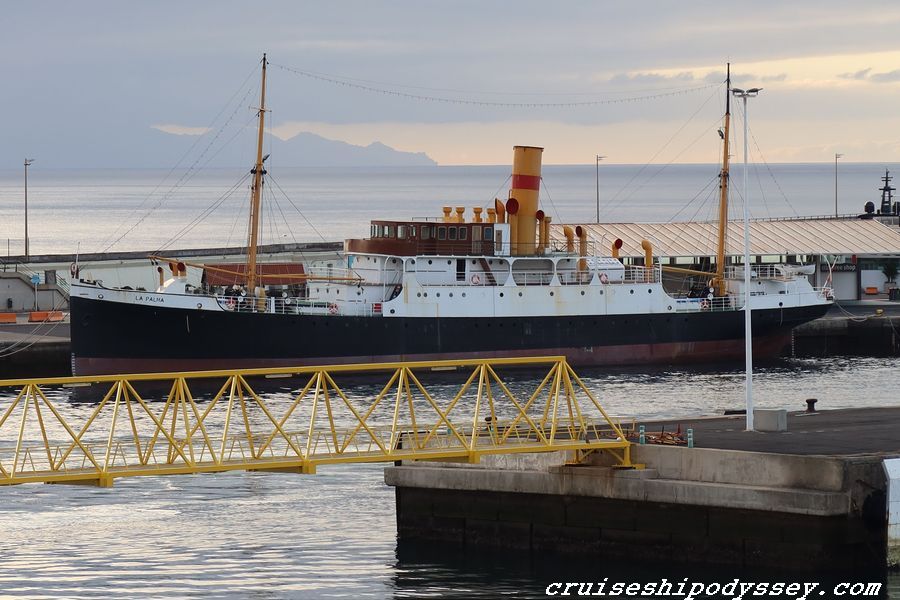
At the end of January 2026, our cruise ship docked in the port of Santa Cruz de Tenerife. Early in the morning and full of anticipation we opened the curtains of our stateroom and there, in the far corner of the harbour, she was, the La Palma, a classic passenger liner dating back from 1912 and one of the last survivors of the Edwardian era! That morning, we had asked for a ship visit and we received a warm welcome from Ayoze Alvarez, cultural manager of the Fundación Canaria Correíllo La Palma (foundation of Canary Islands historic mailship La Palma) and Clive Dwyer, a member of the ship’s team of dedicated volunteers. This all brought back memories, as I had visited one of her sister ships, the Viera y Clavijo, during a maritime event in Rotterdam, the Netherlands, almost half a century ago in 1978. (See the photos I took in 1978 on the Viera y Clavijo photopage)
La Palma was constructed by W. Harkess & Sons Ltd., in Middlesbrough, England, as yard no. 192, for Cia de Vapores Correos Interinsulares Canarios, based in Las Palmas and associated with shipping company Elder Dempster of Liverpool. She was the final unit of a series of three sister ships, the others being Viera y Clavijo (1912-1984) and Leon y Castillo (1912-1981). La Palma has the following main particulars: 894 GRT, 1,503 tons displacement, 67 meters length overall, 64 m. bpp, 9 m. width, 6 m. draft. She was fitted with a triple expansion steam engine developing 965 SHP, a single screw ship, with a speed of 11 knots and accommodation for 190 passengers in three classes.

Launched in in the River Tees in February 1912 she was completed by her builders in April 1912.
When La Palma was delivered to her owners, this was just 4 days before the infamous Titanic hit an iceberg on her maiden voyage on April 14 1912! She left the yard on April 16 under the command of captain D. Aurelio del Arco. After a stopover in Bremen she arrived at Las Palmas for the first time on April 24. Her first call at Tenerife was on May 5, 1912.
The ship sailed as a “correillo” (as Canary inter island mailships are called) between the Canary Islands from 1912 to March 16, 1976. This service was so important for the local communities that when, in later years, the smaller quays were closed to limit the service to only the larger ports and thus make it more profitable, many islanders lost their lifeline and could no longer conduct their trade. In many cases, they even emigrated to build a life elsewhere. Together with her sister ships, she served as the primary lifeline between the islands before the age of modern ferries and aviation. Before her inter island traffic was slow and unpredictable. They were the first to provide a reliable schedule, carrying everything from vital mail and tropical fruits to local families and livestock.

Some high- and lowlights during her active career:
– She was called for active war duties along with her other two sisters until the end of World War I in 1918.
– In January 1925 she stranded on a reef as a result of heavy storm but was refloated.
– Four years later in 1929 a fire broke out onboard which could quickly be extinguished by her crew, causing little damage.
– In December 1930 La Palma assisted the gunboat Uad Ras which had run aground in Cala Fuster (Fuerteventura).
– In September 1931 she came to the rescue again, helping the fishing trawler Tordera trailer which was adrift because of a tail shaft fracture about 200 miles north of Tenerife.
– On July 15, 1933 La Palma collided with the vessel Golden Eagle causing damage amounting to 10,000 Pts (60 €)….
– In February of 1934 she assisted to get the fishing vessel Peter afloat again which had run aground near Cape Juby (south coast of Marocco).
– In July of 1936 she was again called for war duties as lightly armored war transport until in 1938 when she returned to the inter-island service.
In 1930 she was sold to Spanish ferry company Trasmediterranea and in 1951 modernization work was carried out, for example oil burners were fitted so she could run on oil instead of coal, making her more cost efficient to operate. Her long working career ended on September 17, 1976 when she was laid up in Las Palmas after one of her boilers had blown up in the port of Arrecife, Lanzarote, the day before and she had limped back to Las Palmas. She was sold the following November 12, purchased at public auction for the amount of one and half million pesetas by a business man Mr. Juergen Flick.

His idea was to convert the La Palma into a club, casino, restaurant and museum at the Marina de Las Palmas but this was not to be as the ship’s owner could not meet the requirements of the city council of Las Palmas. He encountered bureaucracy and misunderstanding from literally everyone of the public bodies whose approvals were needed and Mr. Flick soon ran out of patience.
Finally, on December 6, 1982 the City Council at last unanimously agreed to purchase the La Palma from Mr. Flick to make it a cultural center, and to achieve this, even a committee was formed. Sadly, these plans never materialized and the ship deteriorated over time. In 1986 the owner offered the ship to the Cabildo de Tenerife (Tenerife island council) which immediately led to a reaction from the Ayuntamienton (city council) de Las Palmas but it was too late and the ship was towed to Tenerife with plans for restauration.
On March 13, 1986, she arrived in the port of Santa Cruz de Tenerife. However, the local shipyard went bankrupt, and the restoration work never got off the ground. La Palma, having been lifted out of the water subsequently lay ashore at the shipyard for 22 years. With her holds open and exposed to the elements, her condition deteriorated rapidly. Also, much of the ship was looted during the years of neglect, adding extra complications for the restauration team in later years. So it looked like La Palma was destined for the scrapyard…

Ten years later, there was finally a glimmer of hope: in 1996, the Canary Association of Merchant Navy Captains, deeply interested in the history of this unique ship, created the Commission Coreillo La Palma in order to preserve the vessel. In May 1997, they organised the visit of a technical team of The Maritime Trust, who at the time coordinated the restoration of historic vessels like the Discovery, the Victory and the Cutty Sark, among others. The expert opinion issued by The Maritime Trust after surveying the ship was a great endorsement for Correillo La Palma: “The ship is in perfect condition for restoration. The goal should be to restore her to sailing condition. “

In December 1997 the Association for Restoration and Conservation Correillo La Palma was founded with the main goals of raising funds for restoration and to convince the authorities of the need to preserve this piece of Canary Island history.
In 1999, the School-Workshop Steam La Palma was organised under the responsability of Cabildo Insular de Tenerife (island council) and ICFEM (Canary Islands Institute of Training and Employment). Thirty young students learning for welder, plumber etc. used the ship as a hands-on site to learn their trade.
Thanks to these impulses, on November 29, 2002, the Cabildo Insular de Tenerife, the ship’s owner, decreed the establishment of the Canary Foundation Correillo La Palma, a non-profit foundation aiming at raising the general interest to restoring the La Palma and having it sail again. The Foundation collaborates with schools like the University of La Laguna, Nautical Training Center- Fisheries and Hospitality courses.
Things were really looking up when in 2003, the city council of El Hierro as well as the isles of La Palma, La Gomera and Fuerteventura joined to support showing the old mail ship really was important to the Canary Islands. The ship was granted historic status in 2003 and finally, the first major restoration work of the old and worn Correillo could be initiated in November 2004. They were lucky with the help of D. Jose Serrano Camacho who had worked on one of La Palma’s sister ships, Viera y Clavijo as an apprentice in the 1960’s having an extensive knowledge of the technical part of the La Palma.

Several hull plates were replaced in 2007. It is still clearly visible today that part of the hull was originally riveted, and the new hull sections were welded in place. Also, the engine room was emptied, the MacColl & Pollock triple-expansion engine was removed for rebuilding as were her troublesome boilers so they could be scrapped. Various parts remain in storage, some items from the ship’s interior along with the propeller.
After being relaunched in 2008, La Palma now lies docked in the port of Santa Cruz de Tenerife and is being restored step by step by volunteers, with the necessary funds provided by the island council of Tenerife among other parties.
The wheelhouse, originally made of wood and in poor condition after a long lay-up period, has now been rebuilt from steel and the open bridge has been closed not only to protect her future crew from the elements but also to meet modern nautical requirements.
On her decks, which are currently bare steel and are expected to be (partly) covered with wood over time which will significantly enhance the ship’s classic appearance, we see the ventilation cowls with handles for manually adjusting them to the direction of the wind when stationairy in port, a beautiful classic feature, a precursor of air conditioning. It’s just one of the original features still visible on La Palma. The forward lounge just below the bridge has recently been completely re-panelled, and along with the original staircase to the deck below, it is one of the jewels on board. A nice detail: the ornamentation on the corners of the staircase was different on each of the three sister ships.

Below decks, rght at the front of her bow, we see a round lid in the floor giving entrance to a cramped space where a crew member had to lower himself into to neatly stow the anchor chain. Not a job for someone with a fear of narrow spaces! Also forward below deck, the hooks where the crew bunks were once attached to the ship’s hull are still present.
The interiors of La Palma are currently largely empty, but there are plans to reserve space for events/presentations, a restaurant and to convert part of the ship into a museum. There is still an incredible amount of work to be done, like replacing wooden bulkheads so that cabins can be recreated as they once were which will help to make her a living museum giving an insight into her heyday.
The number of portholes still show where the first (two portholes), second (one), and third class (none…) accommodations used to be. And what to think of the bridge, where new navigation aids are to be installed, restoring the captain’s cabin and maybe even the wireless operator’s cabin and so on.
The engine room is the heart of La Palma and will be fully restored but maybe for practical and financial reasons with a new modern engine installed while the old engine could be replaced just to be put on display instead of having it rebuilt.

As already mentioned many different plans were made over the years like using one of her holds for exhibitions and an art gallery, creating a large hall for presentations, conferences and special events and adding a restaurant/ cafeteria which would cater for around 50 people. Also, the stern hold could become a library and museum dedicated to the science of navigation and/ or the history of the Canary Islands. How much of all the plans can be realised obviously depends on the available funds…
When, in, 2003, La Palma’s historic significance was finally recognized, the restoration foundation Fundación Canaria Correíllo La Palma (with Juan Pedro Morales as its current president) was formed with the goal of not only restoring La Palma as a floating museum, but also making her operational once again in the long run. Not only Tenerife, also several other Canary Island governments support these goals so far and up to the present day, several million euros have been spent on the project. The Foundation Canaria Correíllo La Palma, which continues to work with its team of volunteers on the restoration of La Palma, would ideally like to see the ship back in active service around 2030. This would allow her to make short trips between the Canary Islands, her original domain and to organize onboard events and ship tours when she is in port. Meanwhile, a shipyard is once again active in the port of Santa Cruz de Tenerife, a new dry dock from China is on its way and La Palma will be the first ship to use it.
We can’t wait to see La Palma, a true survivor, set sail again!
What happened to her two sister ships Viera y Clavijo and Leon y Castillo?
Leon y Castillo

Also built in 1912 by W. Harkess & Sons in Middlesbrough, England, being commissioned by the Compañía de Vapores Correos Interinsulares Canarios. She was named after the influential Canarian brothers Juan Leon y Castillo, an engineer, and Fernando Leon y Castillo, a politician and diplomat.
In her early years 1912-1930, the Leon y Castillo provided a reliable inter island schedule, carrying everything from vital mail and tropical fruits to local families and livestock.
In 1930, the ship was integrated into the fleet of Compañía Trasmediterránea. During the Spanish Civil War and World War II, she continued her inter-island service, often painted with neutrality markings (the Spanish flag) painted on her hull, to avoid being targeted by submarines. To keep up with modern standards, she was converted from coal-burning to oil-burning in 1951, which extended her operational life significantly.
From the 1970’s unti 1980, she sailed the African “Piojo” Line (1970s–1981), as faster diesel ships took over the Canary routes, the Leon y Castillo was reassigned to the “Línea del Piojo”, connecting Algeciras, Ceuta, and the Chafarinas Islands off the coast of Morocco. Despite her age, her sturdy construction kept her in service long after her contemporaries had been scrapped.
By the early 1980s, the Leon y Castillo steamship was an ancient relic in a world of fast ferries. and she was officially retired in 1981. While there was hope of preserving her as a museum ship (similar to her sister ship, the La Palma, which survives today), the Leon y Castillo did not share that luck. She was sold for scrap and dismantled in Las Palmas de Gran Canaria in 1984.
Viera y Claviyo

Built by the Caledon Shipbuilding & Engineering Co. in Dundee, Scotland, the Viera y Clavijo was part of a fleet commissioned by the Compañía de Vapores Correos Interinsulares Canarios. The Viera y Clavijo had an incredibly long career, starting 1912. The ship was named after José de Viera y Clavijo (1731–1813), the most famous historian and polymath of the Canary Islands, who wrote the definitive General History of the Canary Islands.
She survived both World Wars and the Spanish Civil War, eventually being absorbed into the Compañía Trasmediterránea fleet in 1930. She continued sailing until 1976, totaling 64 years of service! In November 1976, the Spanish shipping company Trasmediterránea sold the Viera y Clavijo to to the Dutch industrialist Johan van der Marel for approximately $83,000 (roughly 5.7 million pesetas at the time). While Van der Marel was primarily a shipbreaking and salvage firm based in Ouwerkerk (province of Zeeland, The Netherlands), the Viera y Clavijo was spared the torch due to her historic value as one of the last “Correíllos Negros” (Black Mail ships). After arriving in the Netherlands, the ship was renamed Jomar (a portmanteau often used by the Van der Marel family) in 1978 and registered in Duiveland (Zeeland). She was converted into a floating museum and restaurant in Zierikzee, where she served as a prominent landmark and museum ship under her original name Viera y Clavijo.
Unfortunately, maintaining a vintage steamship is an expensive labor of love. Despite the efforts to preserve her as a museum, the Viera y Clavijo eventually fell into disrepair. After several years of service as a static attraction in the Netherlands, she was eventually scrapped in 1984 at the Van der Marel yard in Ouwerkerk, though parts of her (like the engine) were saved by maritime historians.