During the years from 1970 onwards, the cruise industry has developed into an important holiday product, with around 35 million passengers in 2024 and an expected growth rate of 10% per year.
In the 1960’s and 1970’s, at the start of this new era, Norwegian Caribbean Line, Royal Caribbean Cruise Line and deluxe cruise line Royal Viking Line had their respective ships mostly financed by Norwegian shipowners willing to invest in this new part of the travel industry. Carnival Cruises struggled to build a fleet converting three former liners to cruise ships (some of the the work was even carried out while the ships were in service by closing off certain areas).
The Caribbean was the principal cruising destination with ships lining up in Miami for week-long cruises to St Thomas, St. Maarten and other destinations in the Caribbean. NCL started the trade in the mid sixties with a former cruise ferry named Sunward. She is regarded as the cruise ship which started modern day cruising. At the beginning of the seventies NCL, Royal Caribbean and Carnival each operated 3 or 4 ships in the Caribbean. Royal Viking Lines’ Royal Viking Sea, Star and Sky sailed around the globe on longer itineraries for a more wealthy clientele.

1n 1966 the delivery took place of what was later to be the first NCL-ship Sunward to Knut Kloster, founder of NCL, a Scandinavian-style ferry for 7 day roundtrips Southampton – Vigo – Lisbon – Southampton for his Kloster Sunward Ferries company. Although marketed as cruises, passengers could take their car with them. Danish architect Knud E. Hansen and C. Barclay, managing director of Kloster Sunward Ferries’ British division were in charge of Sunward‘s design. Her exterior clearly showed the Knud E. Hansen ferry design approach. Barclay designed most of the interior lay-out. She emerged as an upgraded Scandinavian short sea ferry suitable for her planned cruise service. Public rooms occupied the full length of the boat deck. Forward was the main lounge with views over the bow, midships the galley and a also an a la carte grillroom on the port side next to a veranda lounge starboard side. Aft her dining room with buffet-isle in the center was situated. One deck up on the Sun deck a veranda saloon and a snack bar which turned into a night club in the evening were located adjacent to the pool and lido area. On the cabin decks below the remaining public rooms could be found: the main foyer, shops, cinema, sauna and children’s room. Apart from the reading and grill rooms, all other public rooms could seat 60%mof her passenger complement. This was done because of bad weather conditions to be expected in the Gulf of Biscay when more passengers would want to stay inside than usual. Danish designer Mogens Hammer was commissioned to design Sunward‘s interiors. The results were functional but elegant scandinavian-style interiors. Part of her accommodations were designed with the luxury compartments of the Orient Express in mind, being compact convertible bed-sitting rooms.
However because of political difficulties between the UK and Spain, Sunward could not start sailing on her intended itinerary. At the same time, Ted Arison who was busy starting up his own cruise line had to return the two cruiseferries Bilu and Nili he had chartered to their Israeli owners because who faced financial difficulties. So Arison had the passengers and Kloster a ship. Soon they had a business agreement and Sunward started sailing for Norwegian Caribbean Line. Sunward is seen as the ship that started modern day (mass-market) cruising. Kloster and Arison did an outstanding job advertising their cruise product. The success of NCL was such that the company needed more ships asap for making it the first fleet of the Caribbean and two newbuildings were ordered from AG Weser’s Seebeckwerft in Bremerhaven.

Again, Knud E. Hansen designed these ships. They were longer with an extra deck in their superstructure and with the same instantly recognizable ferry-derived exteriors. Starward and Skyward both had a dummy funnel, a glass enclosed dome left open at the stern containing a two deck lido with a bar and lounge at its lower level and covered deck space above, .Starward was originally fitted out as a ferry with space for 168 cars, but within a few months after her delivery when she switched to the longer 7-day Jamaica cruises this was replaced by additional passenger accommodation. Skyward, completed later in 1968 was delivered without a car deck.
Southward, soon ordered afterwards as well as Seaward bothe were ordered form the Italian shipyard Cantieri Navali del Tireno e Riuniti followed the same concept as Starward and Skyward but had their lifeboats lowered three decks. Southward emerged with the same internal plan as her predecessors, but her dining room was now situated on the boat deck beneath the public lounges.
As planned, now NCL had four ships in active service. For a fifth, to be named Seaward a lower price was negotiated with the yard but when this proved unsuccesful, the vessel was rejected and later she became P&O’s Spirit of London in 1972.
Competition for NCL emerged when Edwin Stephan founded Royal Caribbean Cruise Line in 1968 for which he arranged financial backing for three ships ordered from the Finnish shipbuilder Wartsila. After an early career in Miami’s hotel business, in the 1960s Stephan joined Yarmouth Steamship Co. and later Commodore Cruise Line. In 1968, Stephan went to Oslo seeking investors for his concept of a line that would start with a ship purpose-built for Caribbean cruising. He succeeded in getting financial support of Anders Wilhelmsen & Co., I.M. Skaugen & Co. and Gotaas Larsen. Work started in Finland at the Wartsila yard on the 724-passenger Song of Norway. This 17,500gt newbuild cost $14.3m and departed on her inaugural sailing from Miami on Nov. 7, 1970. Again, the new ships’ design was in the capable hands of Knud E. Hansen (like those of yet another newcomer Royal Viking Line). RCCL also used the services of naval architect Martin Hall of I. M. Skaugen who worked together with Gier Grung who was responsible for its interiors. Also contrated was the Danish interior architect Mogens Hammer.

Stephan had the idea to distinguish the RCCL-ships from those of the competition by placing an observation lounge high up in the funnel having the form of a disc attached to the back of the funnel. Inspired by Seattle’s Space Needle, it gave the RCCL ships a distinctly modern almost jet-age look.
Royal Viking Line was formed 1972. Each of the line’s initial three vessels was owned by one of its initial investing partners. The first, the Royal Viking Star, was completed in July, 1972. Its owner was Bergenske Dampskibsselskab (Bergen Line). The second, the Royal Viking Sky, was owned by Nordenfjeldske Dampskibsselskab of Trondheim. She was completed in July 1973. The third ship, the Royal Viking Sea, was ready in December of the same year. Her owner was A. F. Klaveness & Co, Oslo. Royal Viking Line ships would not sail repeating Caribbean itineraries but on world wide unique cruises. Almost 50(!) lines and cruise ships were studied to establish the definitve design of the Royal Viking Line ships. When delivered, they showed design aspects from QE2’s catering arrangement, namely placing the restaurants and galleys fully forward to ease pasenger flow on the aftpart of the decks as well as from the Oceanic (1963, Home Lines) and Eugenio-C‘s (1966, Costa Line) placement of public rooms on the top deck above the lifeboats for better views and shelter from the elements.

Royal Viking Line’s had Warren Titus, with previous cruising experience at American President Lines and P&O, as Company President and Marketing Director at their San Francisco headquarters. His influence included shipboard design and décor, which became the standard for luxury cruising. His ships built up a good repeat business especially with mainly older, well-travelled discerning customers.
Most of the interior design work on the Royal Viking Line ships was done by Finn Nelson of the Norwegian firm IS Plaateau who was known at the time for his designs for the interiors of Sagafjord (1965, Norwegian America Line). They featured sharply raked bows and an abundance of deck space. Their funnels resembling that of QE2 (1969, Cunard Line) according to some were instantly recognizable, having three sections with the engine exhaust pipes in the higher mid section and the red Royal Viking logo on the white casing of the outer sections. They had accommodation for just 539 passengers compared to 750 – 800 on similarly-sized ships of other lines in cabins located on eight passenger decks, named Sun, Sky, Promenade, Scandinavia, Atlantic, Pacific, Mediterranean and Sauna decks. Top accommodation were 32 deluxe three berth cabins consisting of a bedroom, sitting room and bathroom.

Airconditioned throughout, Royal Viking Line ship featured public rooms consisting of the dining room, main lounge, observation lounge above the bridge with marvellous 270-degree views, Sky Bar, a two-deck theatre placed in the two lowest passenger decks a night club, Lido Bar and of course a library, gift shop, beauty salon and barber shop. Royal Viking Line prided itself on single-seating dining, and the main restaurant was situated unusually high in the ship, with large windows again offering great views.
In 1972, after a fall out with his business associate Knut Kloster, Ted Arison started his own cruise company Carnival Cruise Line and he needed a ship fast to continue the succes with Sunward he had had together with Kloster during the early days of NCL.
The company’s first ship, Mardi Gras, the former Empress of Canada (1960 of Canadian Pacific was sold to Carnival Cruise Line in January 1972. She only underwent a few internal changes and an update of her colour scheme as the new company did not have enough funds at its disposal at the beginning to do more. They just wanted to have her in service asap. Their second ship Carnivale (ex Empress of Britian – 1956, Canadian Pacific, Queen Anna Maria – Greek Line) acuired in 1975 was tretaed the same way. With a modernised decor she started service for Carnival. Both ships were continuously upgraded while in service with work carried out in sections closed off. Then in 1977. S.A. Vaal (1961, Safmarine) was sold to Carnival Cruise Line and renamed SS Festivale.

Carnival converted her into a cruise ship in Japan at a cost of $30 million, removing former cargo holds and enlarging her superstructue and doubling the vessel’s passenger capacity, installing lounges, a discothèque and casino. She was the line’s first ship which wasn’t just updated but was actually converted into a modern cruise liner. It was the beginning of their house interior architect Joe Farcus’ philosophy were he wanted “the ship to become the destination”, introducing the term “entertainment architecture” where the ship is more than just a means of transportation, its facilities and themed decor making it a destination in itself. Thus, the Festivale became one of Carnival’s first generation of fun ships, a slogan thought of by later vice-president of sales and marketing Bob Dickinson when crew members who had also worked on her for her former owners mentioned she had always been great fun, a happy ship both for crew and passengers alike.

In the UK, Cunard Line operated the Queen Elizabeth 2, which divided her time between liner service on the North-Atlantic and cruising. Cunard added four purpose built cruise ships between 1971 and 1976 to its fleet while P&O disposed of their older liners which could not compete anymore with the jet airliner and were not suited for cruising. Canberra, Oriana and Arcadia, liners from orgin were pushed into cruise service with just minor changes to their interiors.
Outside of the Caribbean, Sitmar Cruises, Princess Cruises and Holland America started focussing on cruising in Alaskan waters.
In North American waters, mostly older tonnage was used by Sitmar Cruises, Home Lines, Costa Cruises, Lauro Lines and Chandris Lines. This showed that cruising was still in its infancy as these ships were mostly former liners more or less adapted for cruising.
Two fine examples of former liners completely stripped and converted to cruise ships were the Victoria (converted in 1958 for Incres Line) and the Stella Solaris (converted 1970-1973 for Sun Lines).
The Victoria
The Victoria was built by Harland and Wolff of Belfast in 1936 as the combination passenger cargo liner Dunnotar Castle for Union-Castle Line for the company’s round Africa service from London. During World War two she served as an armed merchant cruiser and troop transport and after the war in 1949 was returned to Union-Castle and she resumed her round Africa service. In 1958, she was offered for sale and was bought by Incres Lines who were looking for a suitable ship to rebuild into a luxury cruise liner. A complete rebuilding took place at the Wilton-Fijenoord shipyard in Rotterdam, transforming her into the sleek, deluxe Victoria. She was given a new bow and stern and her superstructure was vastly enlarged and modified. Her Burmeister &Wain diesel engines were replaced with brand new twice as powerful Fiat engines. The only original parts of the ship remaining were the hull and inner part of her upper superstructure, like the bridge and officer’s quarters.

Gustavo Pulitzer-Finale was responsible for Victoria’s modern and classy interior styling, which showed an abundance of fine wood paneling and trend-setting midcentury Italian furniture. Her decks were named after (semi-)precious jewels with matching colors. On Emerald Deck, one would find green colored bannisters and carpeting. Same for Amber, Coral and Sapphire decks. Victoria had a dining room with a barrel shaped domed ceiling and musician’s balcony as well as a two deck high auditorium. Emanuele Luzzati created most of the artworks, which were based on Roman themes and also added metallic panels and ceramics. 214 new deluxe cabins were constructed on the four lower passenger decks. In her newly built superstructure an array of new modern 1960’s style public rooms were created.
High operating costs partly because of the fuel crisis made Incres Line fold in 1975 and the Victoria was laid up at Brooklyn. Chandris Cruises purchased the then 39 year old ship for spare parts and furniture to use for their other vessels. However after a thourough inspection, they realized she still was in quite a decent shape and would make a great addition to their fleet. So instead of stripping her and selling her for scrap, they refitted the ship and slightly changed her name in The Victoria, increasing her capacity from 430 to 548 passengers.
Stella Solaris
When Messageries Maritimes closed down their liner services from Marseilles to Yokohama via the French territories of Indo-Chine, one of her liners put up for sale was the Cambodge of 1953.
At the time Greek shipowner Haralambos Kioscoglou had just started his own shipping company. He had worked before for Home Lines so he new the liner/ cruise industry well. He aimed at building up a fleet of intimate yacht-like vessels with a high level of service. He acquired Cambodge to be rebuilt to fit his concept which he had also implemented on his other two ships, the Stella Maris and Stella Oceanis, both considerably smaller than his third vessel which he renamed Stella Solaris.
During her conversion from liner to cruise ship, She was completely stripped with only her hull and engines remaining.

After having been rebuilt from scratch her Boat Deck contained most of the first class cabins with the card room and reading room aft of the passenger accommodations. A teak promenade encircled the Boat Deck, which was specifically designed to slope towards the midships section inorer to compensate for the swaying of the vessel. Solaris deck was reserved for public spaces with the main dining room located just aft of the ship’s galley. The small Bar Grill was located starboard of the dining area. Midships, the purser’s office and ship’s reception area as well as the primary entrance area of Stella Solaris could be found and further aft the Solaris Lounge and Piano Bar. Lower decks mainly had passenger staterooms with 32 deluxe saterooms midships ons Golden and Ruby decks. The main entrance area of the Stella Solaris on Emerald deck had recessed circular lighting inspired by 1950s Italian ocean liners. The ship’s cinema was located aft on Sapphire deck with the discotheque located underneath it. Stella Solaris had a loyal following during her long career which lasted until she was scrapped in 2003.
Chandris Cruises, Royal Cruise Line and Costa Cruises pioneered the so called fly-cruises in the 1980’s, where passengers are flown to their ships to join them there, which was mostly in the Mediterranean and the Caribbean. Royal Cruise Line’s Golden Odyssey was designed with a passenger load exactly matching the capacity of a Boeing 747! A bit ironic that the airplane which caused the demise of liner-service now helped cruise ships fill their staterooms….
At the time companies were struggling financially as they owned mostly vessels in the 10.000 to 20.000GRT range, carrying around 700 passengers which is by far not enough to profit from economies of scale. Calculations showed that companies should own at least six ships to be profitable as margins per vessel were extremely low. Ships of this size were considered ideal for cruising at the time, but both Carnival and Royal Caribbean saw the need for larger tonnage, especially when Kloster acquired the France in 1979 to convert her into the world’s fist mega-cruise ship. Carnival ordered the Tropicale (1982, 36,674GRT) and Royal Caribbean the Song of America (1982, 37,584GRT). But it would not be before the mid eighties when Royal Princess (1984, 44,588GRT, P&O Princess), Holiday (1985, 46,052GRT, Carnival Cruises) and her slightly larger sisters Jubilee (1986, 47,262GRT ) and Celebration (1987, 47,262GRT) were introduced that cruise ship size considerably grew.
Royal Princess
P&O Princess, in order to keep up with the Big Three, Carnival, NCL and Royal Caibbean, was in need of new and larger tonnage, to add to their existing fleet of Sun Princes, Island Princess and Pacific Princess.
A newbuilding was ordered from the Finnish Wartsila yard. They came up with a completely new idea. By moving the public rooms to the upper part of the hull, it was now possible to place a small “hotel block” on top of it. A a result, they could realise all outside cabins (AOC) in this new ship. This AOC concept was not new as ships like L’Atlantique (1930, French Line) , the KDF ships WiIhelm Gustloff (1937) and Robert Ley (1938) and even the Russian 5-ship Poet-class of the 1960’s had featured this AOC conept.

Royal Princess´s interiors were designed by Hirsch & Bedner from Los Angeles and Njal eide from Oslo. They succeeded in creating warm, elegant public spaces, in corridors and stairways neutral colours were used, while in bars and lounges brighter colours and brass could be found. The new ship would have the lay-out of a land-based hotel, with activities like dining, gambling and attending shows all taking place “downstairs”. P&O stated they wanted the ship to have the feel of an upper class California home referring to a minimalist styling popular in California at the time mainly seen in luxury homes and hotels. All staterooms placed on the upper decks of the ship would be uniform in lay-out, again like hotelrooms. Of the 600 cabins, 38 were placed low in the hull beneath the two decks of public rooms, but they also were oustide cabins.
The Horizon Lounge, an observation lounge by day and a place to dance at night reminds one off RCCL’s famous Viking Crown lounge. It seated 200 passengers. Royal Princess also had a small but spacious two-deck atrium called The Plaza, one of the first small atria aboard a modern cruise vessel designed by Norwegian interior architect Njal Eide. with the Princess Court Lounge, a piano lounge encircling it at the top level. A portrait of Princess Diana, who christened the ship in 1984 graced this room. The Pursers lobby and foyer was situated in the atrium’s lower level on Plaza deck and featured a brass staircase leading to the earlier mentioned Princess Court on Riviera deck. The foyer was dominated by “Spindrift”, a two deck high sculpture featuring bronze seagulls, a fountain and lots of greenery. Original plans were for an atrium to be realised midships rising through all decks of the hull with a dome on top but for fire safety reasons this was scaled down to a double height atrium. The art collection aboard Royal Princess was chosen by art consultant Neil Menzies from California.
Today, impeccably maintained and a very popular cruise ship, after just another multi-mollion dollar upgrade, she is still sailing as Artania for Phoenix Reisen from Germany.
Taken into service in 1982, Tropicale was Carnival’s first newbuilding. Her internal lay-out seemed quite old fashioned with her two closed promenades, but these made an extra large casino possible midships, because guests could pass the casino on either side. Tropicale introduced many novelties as well, for example a tiered show lounge where extra height was taken from the lounge below by introducing a sloped ceiling there. On this ship, designer couple Joe and Carole Farcus went all out as could be seen in the Exta Z discotheque with its translucent dance floor with lighting effects underneath and ceiling with strobe lights mounted in an open framework and as well in the informal bar on the Boat deck called the Boiler room where the ships technical workings were left visible with dummy fittings and pipes added to enhance the effect. The other public rooms of Tropicale were less dramtic but still with very colourful and lively designs. Concerning her staterooms which were highly standardised, for the first time the separate or double bed dilemma was solved by making it possible to move the beds around in the cabin, joining or separating them. Simple as it may sound, this was not done before by other lines.
Her modern appearance was completed by her winged funnel. For his first newly built ship Tropicale in 1981, Ted Arison asked interior architect Joe Farcus to design a hallmark funnel for Carnival Cruise Line. As an airplane as well as shipping enthousiast, Farcus thought that the principle of vacuum created on top of the wings of an airplane could also help in lifting smoke off the decks of a ship and he designed a funnel with wings on top of both sides. The Danish shipyard building Tropicale thought it would never work but windtunnel tests proved them wrong. It was realised on Tropicale and has been used on every Carnival ship to date. Farcus’ revolutionary funnel has been compared to France/ Norway’s funnel which also had wings, but internally these worked completely different as a shutter could be used to divert smoke from the top to the sides of the funnel.

In 1982, Royal Caribbean took delivery of the Song of America. Contrary to Tropicale, her interiors were designed by multiple interior designers, namely Mogens Hammer, Njal Eide and Finn Nilsson. They were asked to give this new ship a distinctly American style as was seen at the time in North American hotels and espcially those found in Las Vegas. However compared to Royal Caribbean’s first generation of ships with their light Scandinavian-style interiors, Song of America‘s interior design showed les vibrant colour schemes, the use of smoked glass surfaces and with bright metal accents added. For the interior layout of their new ship RCCL decided to adapt a system with cabins placed forward in the ship, furthest from engine noise, and public spaces aft. This layout was widely used on ferries built by the Wärtsilä shipyard, but up till now had been rarely used for cruise ships. Song of AmericaTropicale was innovative with its main show lounge, being one of the first use of structural web frames instead of multiple columns, greatly improving sightlines compared to other ships. The public spaces on decks five and seven were built with 1½ times the standard deck height, resulting in very spacious public rooms.
By far the largest cruise ship owner in the 70’s and 80’s was the Soviet Union, which operated four series of passenger ships, the Ivan Franko/ Poet-class (5 vessels), Mikhail Kalinin-class (19 vessels), Kirgizstan-class (9 vessels) and Belorussija-class (5 vessels, originally built as ferries but ;ater converted to cruise ships). They divided their time between liner service and cruising, in order to generate western currencies badly needed by Russia.

They were not very luxurious and sometimes even a bit spartan but for very reasonable fares, travellers could make a cruise on a Soviet cruise ship. They were well run and soon became very popular ships, especially the poet-class quintet.
However, most cruise ships were still quite small with facilities limited to a show lounge, disco, bar, dining room and a small casino, passengers started asking for more (the ship being the destination becoming the new motto in general) and companies were looking for economies of scale, more passengers on board with less crew thus saving on operating costs and increasing revenues.
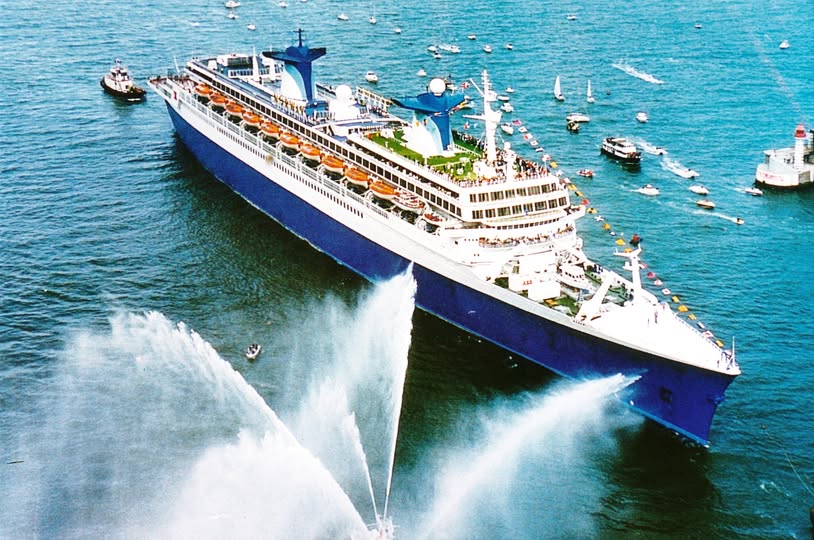
NCL was the first company to take the bold step of introducing a large vessel. In 1979 they bought the laid-up once famous trans-atlantic liner France (built 1962 for French Line) and had her rebuilt into the cruise ship Norway. The era of the mega cruise ship had begun.

In 1979 NCL owner Knut Kloster bought the laid-up France from businessman Akram Ojjeh who had planned for her to serve as storage for his collection of antiques and as a hotel ship in Jeddah. This never came to pass and Kloster only paid18 mio dollars for her (building coststs in 1962 were 75 mio) and the another 40 mio to convert her from liner to cruiseship, a bargain.
France had two separate engine rooms for het 31 knot speed needed in transatlantic service. The forward one was closed off as in cruise service a speed of around 17 knots would suffice. Her outer screws were removed, the innner ones retained but replaced by a more efficient type. Her indoor promenades giving passengers shelter form the often angry North Atlantic were left unchanged, they were named Broadway and Fifth Avenue and mainly used to provide access to the the array of public rooms on the International deck. The tourist class swimming pool with its fixed cover was removed as an indoor pool was not needed while cruising in sunny waters. It was replaced by an outdoor one higher up. As on Holland America’s Rotterdam of 1959, France‘s two classes both had an entire deck at their disposal situated above eachother. Depending on functions (both classes ofcourse had the same public spaces like smoking rooms and main lounges) they were restyled and were given new use. Although public rooms were all changed and and modernised, connecting stairtowers and other remaining infrastructure was kept, although upgraded with a more modern American-Scandinavian design by interior architect Angelo Donghia from New York.


Together with the naval architects Knud E Hansen, his leading designer Tage Wandborg from Copenhagenand American interior designer Angelo Donghia, France was converted from liner to cruise ship in just under a year: 3 months for the design phase and another 8 for the actual conversion work. This was done by the HAPAG-Lloyd yard in Bremerhaven, the only yard able to meet these timelines.
One of the ship’s most impressive public spaces, Club internationale was the former first class smoking room Salon Riviera, which was largely unaltered from her original appearance and lay-out. In this magnificent room, there is a circular stairway to reach the center part. It features a small bar and a dancefloor. On both sides on the lower level, there are views on both indoor promenades and the Oslo deck, one deck up as it is a double-height room. Several fixtures, from the ship’s days as France still remain in place, like the ornaments on the ceilings. New in this room are two statues of ancient Gods, made of semi precious stones, which had to be hoisted aboard by crane because of their tremendous weight. The Club Internationale is without a doubt one of the finest rooms afloat, reminiscent of the glory days of ocean travel, and is often compared to the Ritz Carlton Lounge on Rotterdam V.
Norway had two dining rooms, Leeward and Windward. The Leeward was a two level dining room with interconnecting stairs featuring an enormous chandelier, which was transformed from the former Restaurant Versailles which really was a rather simple and cold dining room. The Windward dining room had been left virtually unaltered. It had a circular form and featured a grand staircase from which passengers could make a dramatic entrance into the dining room. Original murals and grandiose wood-panneling were retained, these added an unmistakable classic charm to this dining room.

Cabins onboard Norway were available in many categories, ranging form small inside cabin which had become a bit outdated over the years being reminiscent of her ocean liner days to luxury outside cabins which had been modernised during her conversion. Later, 135 staterooms in her new two top decks were added. These reflected the latest standard of luxury in cruising, some even had balconies.
Norway proved an immediate succes. In the early 1990’s she returned to the HAPAG-Lloyd yard for the addition of two extra decks to her superstructure to increase her passsenger capacity. Alas, in May 2003, whilst in the port of Miami between two cruises, Norway suffered an explosion in one of her boilers. 8 Crew members were killed in the accident, there were no casualties among passengers. At first, she was expected back in service within a month or two, but repairing the boiler proved to be a lengthy and costly affair as only a few companies have the skills to construct one. She had built up quite an account concerning her “parking fee” in the Port of Miami and it was decided to tow her to Europe to the yard that had given her a new life as a cruise ship, Lloyd Werft in Germany. After many plans to save her in different roles fell through she was scrapped in Alang, India in 2007
Royal Caribbean saw the need to react fast after having seen the succes of NCL’s Norway and they decided to order a series of large cruise ships. They introduced the Sovereign of the Seas (1988), Monarch of the Seas (1991) and Majesty of the Seas (1992). They were the first trendsetting purpose-built mega cruise ships.
Four days ahead of schedule on December 1987, Royal Caribbean took delivery of what was then the largest cruise liner ever built, the 73,192 gross ton Sovereign of the Seas, She had capacity for a maximum of 2,524 passengers in 1,141 cabins, 722 outside and 419 inside. Sovereign of the Seas was notable for having the first modern shipboard atrium, five decks high with glass elevators, sweeping staircases and fountains in marble pools. It was desinged by Njal Eide whose designs later got him the nickname “Atrium Man”. Her atrium was the first of its kind with its enormous size. It wowed guests as this was the first onboard space they would see when embarking the vessel. The atrium called The Centrum was the focal point of the ship, being surrounded by bars, lounges and shops. Although the different levels could be reached by stairs, the glass elevators from where passengers could oversee the atrium from the moving lift were a spectacular novelty at the time. The atriums size and openness also caused problems when the US Coast Guard saw it as an important fire hazard, having disasters like the Morro Castle (1934) and Normandie (1943) fires in mind. Royal Caribbean quickly made the necessary changes by for example having sprinklers installed.

Again, like her predecessor Song of America, multiple interior architects worked on Sovereign‘s interiors: Njal Eide, John McNeece, Robert Tillberg and Petter Yran were all involved. An entire deck was devoted to cabins with private balconies also groundbreaking at the time. The trademark Viking Crown Lounge was still high up encircling the funnel, on later and bigger ships it would be placed on the top deck beause of its size. She featured two 650 seat main dining rooms and a 900 seat two-story buffet restaurant the Windjammer Café high up on the forward end of Sun Deck and top-level Compass deck having both indoor and alfresco outdoor tables. The main dining rooms were placed one above the other each having their own galley for efficiency reasons. Even the Windjammer cafe had its own galley. Her main show lounge was the 1,050 seat two level Follies Lounge and for watching movies she even had two cinemas. A separate live music venue, a nightclub, a casino with 170 slot machines plus table games, and multiple restaurants, bars and lounges offered her passengers an array of amenities never seen before.
With double the number of passengers than Song of America during the design phase special attention was needed for passenger flow and the seating capacity of public rooms. Song of America served as the basis for these calculations, even headcounts were done at different times in several of her lounges, bars etc. to collect the right data to solve this issue.
The first arrival of Sovereign of the Seas in Miami on 4th January 1988 caused a sensation, being the largest vessel ever to enter the port and dwarfing all the other ships there. It was such a milestone in (US-) cruising that the president and first lady of the United States, Jimmy and Rosalyn Carter, were special guests at her naming ceremony on Jan. 15, 1988. Rosalyn Carter as gthe ship’s godmother smashed a record-size bottle of Taittinger Champagne against her hull. ,And when the next day Sovereign of the Seas departed Miami on the first of its year-round 7 day cruises to St. Thomas, San Juan and Labadee, the presidential couple sailed on the maiden voyage of the vessel.

While she was the ultimate in cruise ships for its time, Sovereign lacked many of the offerings of today’s Royal Caribbean ships. She did not have a climbing wall, surfing pool, waterslide complex on her top deck. Nor was there the Royal Promenade with restaurants, bars and shops today’s passengers have grown accustomed to.. The facilities Sovereign did have like a fitness center, large library (2000 books) and so forth are considered as basic on today’s cruise liners.
However Sovereign proved a mega-cruise ship where “the ship is the destination”could be succesfull, not only with its passengers but with the company’s accountants as well. For Royal Caribbean and its competitors, the era of the truly giant cruise ships had begun.
Since the beginning with Sunward in 1966. the cruise industry had seen impressive growth. Smaller cruise ships of around 20,000 GRT and capacity for ca. 600 passengers together with converted former liners were now being replaced by larger newbuildings ranging from the 36,674GRT Tropicale to the 70,000GRT Norway and 73,192GRT Oasis of the Seas-class ships.
In part 5, Cruise ship interior design history: the early days of cruising, we will describe the developements from the 1990’s up to to the present day.